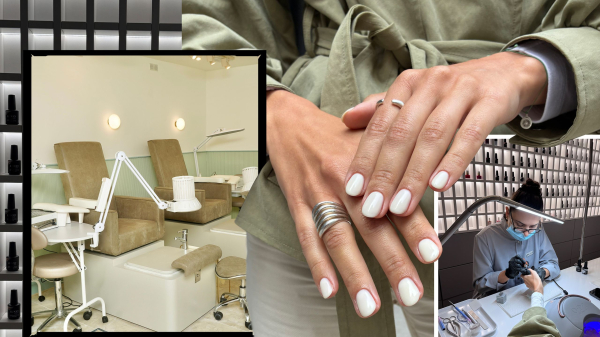

 Collage: Allure; source images: So.Shell, MVKSave this storySave this story
These days, your choice of treatments at the nail salon extends beyond the traditional polish versus gel, French tips versus seasonally-inspired nail art. We now have newer nail systems, like BIAB (or Builder in a Bottle), special effects like cat-eye polish, and more widespread availability of services from around the world like the Ukrainian manicure.
Techniques popular in Ukraine and surrounding countries have steadily filtered into the rest of Europe, the United Kingdom, and the United States, with salons all over the world now offering Ukrainian-style manicures. These meticulous services have a reputation for yielding flawless-looking nails that last for weeks, converting people all over the globe. Maybe you've seen the service advertised at a salon in your area. Maybe you've scrolled past one on Instagram. Maybe you want to learn more. Well, here’s what you need to know about what’s driving this rise in popularity of the Ukrainian manicure, and what these services actually entail.
In this story:LargeChevron
- Why are manicures in Ukraine such a big deal?
- What is a Ukrainian manicure and why is it special?
- Why are Ukrainian manicures becoming more popular globally?
Why are manicures in Ukraine such a big deal?
“From a young age, women [in Ukraine] grow up watching and learning from one another how to take care of themselves—from nails and hair to skin care,” says Vlada Klym, founder of the Browchuk salon in London. “There has always been a strong desire to look and feel your best.”
This philosophy very much extends to the hands. “You can recognize a Ukrainian woman by her immaculate cuticles, as funny as that sounds,” says Alyona Ponomarenko, beauty editor in chief of Vogue Ukraine. “Finding a woman with neglected hands here is surprisingly difficult. In big cities and small villages, across professions and social backgrounds, whatever her workload and however many children she has, a Ukrainian woman will almost invariably have perfectly groomed nails.”
This love of well-groomed nails is evident all over Ukraine. Ponomarenko goes on to describe a relative who works in a drone factory wearing a cat-eye manicure, the DIY store cashier sporting extra-long tips adorned with a sophisticated design, and the market florist who relies on her gel manicure to ensure her nails look beautiful even when she is working the soil. “Even elderly women living on the margins of society are surprisingly likely to have a pearlescent finish on their toenails,” she says.
Viktoria Kolodii, founder and creative director of the MVK salon group, which started in Kyiv, says that while having color on their nails matters to Ukrainian women, the thing they care about most is the care and the manicure itself. (In Ukraine, “manicure” refers to the prep, not the polish part.) “Women want their hands to look groomed: clean cuticles, everything neat and even,” she tells Allure. “I’d say it’s a part of our culture now, to have nice neat nails and take that time for yourself—a rare self-care moment we get being so busy with everything that is going on around us.”
This sobering point is important. Since Russia’s full-scale invasion, and amid the ongoing war, manicures have become an area in which Ukrainians can maintain consistency in a time of intense uncertainty (something we reported on back in 2024). “Nails are one of those tiny aspects of life we can actually control at a time when the air-raid alarm may sound 14 times a day, and at night we sleep in underground parking garages or metro stations to protect ourselves from Russian missile attacks,” Ponomarenko explains. Manicures, she says, remain one of the most in-demand beauty services in Ukraine, regardless of the surrounding circumstances.
The weeks and months that followed Russia’s full-scale invasion in February 2022 were an incredible testament to the resilience and adaptability of the country’s beauty industry—and that remains true today as the war continues. Beauty treatments were carried out in boarded-up salons and in bunkers. “Images of Ukrainian nail technicians doing manicures by headlamp during missile attacks and blackouts have made headlines around the world,” says Ponomarenko. “There is no exaggeration here—this is simply our reality: when faced with any unclear situation, a Ukrainian woman gets a manicure.”
“When the full-scale invasion began, we had 250 to 270 people working in Kyiv," Lera Borodina, founder of salon chain G.Bar, previously told Allure. "We had G.Bars all along the front line, and we had to make decisions on what to do.” Staff were then relocated from eastern Ukraine to salons in the west of the country, or the business’s locations in Poland, Georgia, and Cyprus. Meanwhile in western Ukraine, Ponomarenko told Allure that in Ivano-Frankivsk, where she and her family evacuated, salons reopened within a week.
This wasn’t only about a sustained demand for beauty services. These were businesses with staff who needed to work and earn a living to support themselves and their families, not to mention the Ukrainian economy; salon owners felt a sense of responsibility to both. Decisions to reopen were ones of bravery, solidarity, and patriotism.
Today, headlamps are no longer needed, according to Ponomarenko. “Salons across the country have installed inverters and generators so they can operate independently of power cuts,” she continues. “This kind of energy independence, even at the level of a single salon, means being able to run an autoclave to sterilize instruments, as well as keeping the lights on and powering the lamps and electric nail equipment.” In other words, salons have evolved to be able to continue functioning in the aftermath of an attack.
What is a Ukrainian manicure and why is it special?
As is the case globally, the go-to manicure techniques in Ukraine have evolved over the years. “[In Ukraine] we used to do the classic manicure with [manual] cutting tools,” Kolodii says of the early days of using emory boards and metal cuticle trimmers. “The electric file (e-file) technique existed too, but at first it was not well-known or popular. Clients didn't understand it, and most people just wore regular polish.”
The arrival of hard gel and colored gel polishes changed things. “The longer you wear gel, the harder it is to remove, and it takes time. So technicians started using e-files to remove it. After that, people stopped doing the wet manicure—soaking the nails in water during the treatment—and moved to combined techniques.” (Combined techniques generally refer to those that use both manual tools, like nail file and cuticle trimmers, and electric ones, like an e-file.)
Today, there isn’t one rigid definition of a Ukrainian manicure. Services may differ slightly depending on the salon, but there are a few key characteristics that are usually present. What you will always notice, though, is precision and attention to detail.
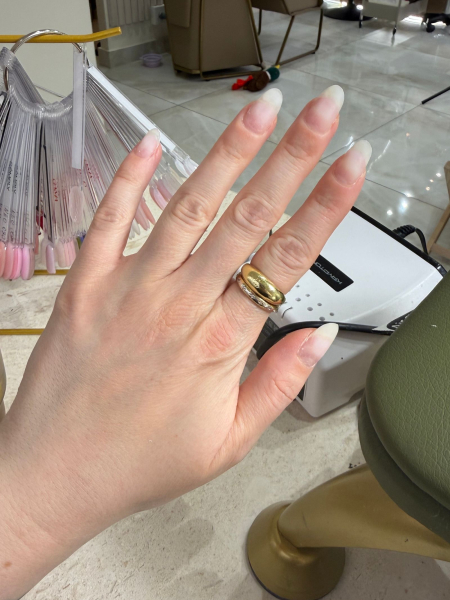
Writer Lucy Abbertseen documented her recent Ukrainian manicure at Browchuk London. This is after her old gels were removed.
Lucy Abbersteen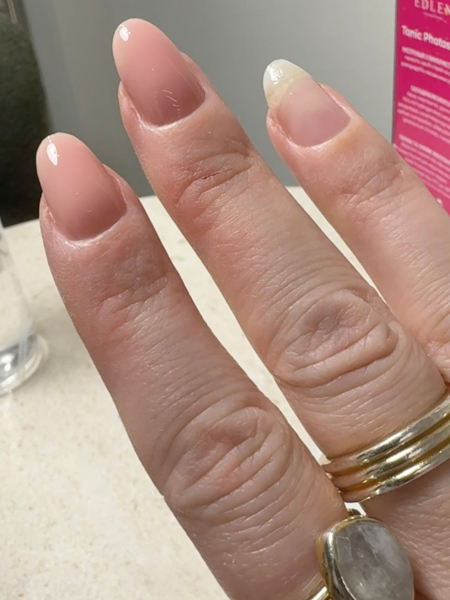
Abbersteen’s nails mid-manicure and polish.
Lucy Abbersteen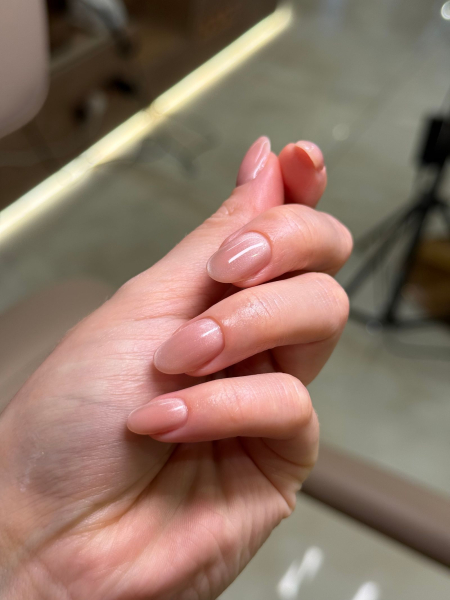
The finished product.
Lucy Abbersteen
In a Ukrainian manicure, much focus is on the nail and cuticle prep. Manicurists use both manual and electric tools to meticulously trim and tidy the cuticles—leaving them as neat as humanly possible—and to prepare and shape your natural nails. This takes up a significant portion of the appointment; any time I’ve had a Ukrainian manicure, around 40 minutes is dedicated to the careful removal of old polish and meticulous cuticle and nail work. The aforementioned attention to detail is always noticeable.
When it comes to gel manicures, rubberized or builder gel formulas are often used to provide extra strength to the natural nails. Ukrainian salons will use both big-name brands and popular Ukrainian ones. In the US, MVK uses OPI and Luxio. These brands also feature at Browchuk London, alongside Ukrainian companies like Touch, Gémely, LunaMoon, Dark by Rior, and Trendy Nails, while London chain So.Shell uses LunaMoon and Komilfo.
Your base coat is applied and cured first, followed by your chosen color, which is carefully painted on and sculpted with a fine detailing brush. During a recent appointment at Browchuk, each of my nails was flipped upside down before curing to ensure an even, curved apex (the shape of your nail when you look at it side-on). This method is common in Ukrainian salons; technicians take a similar approach at So.Shell in London and MVK in New York City.
Once your nails are cured and your technician has refined the shape with a nail file, the services are almost always finished off with oil and cream. Depending on nail length, on average the whole process takes between 75 and 105 minutes.
You can then expect your nails to last for weeks. “One of the key advantages of a properly executed Ukrainian manicure is its longevity,” says Klym. The appointment time may be longer than for other gel manicures—and in many cases more expensive—but that laser focus on cleaning up the cuticles, prepping the nails, and carefully applying the polish is what helps it to last. “The manicure can stay looking fresh and neat for up to five weeks, making it both beautiful and incredibly practical,” Indeed, more than two weeks after my manicure at Browchuk in London, where I’m based, my nails were still beautifully shiny and chip-free. I was able to get at least another week out of them. After an appointment at MVK in New York City, Allure social media manager Katie Gunderman says her manicure lasted “four weeks without chipping…although it obviously started to grow out.” Similarly, Allure content director Sophia Panych remembers a manicure she got at Say No Mo salon in Kyiv that lasted a full three. “I could have probably gone another week, but I was getting married…so I got another Ukrainian manicure in London that lasted another three or four weeks.”
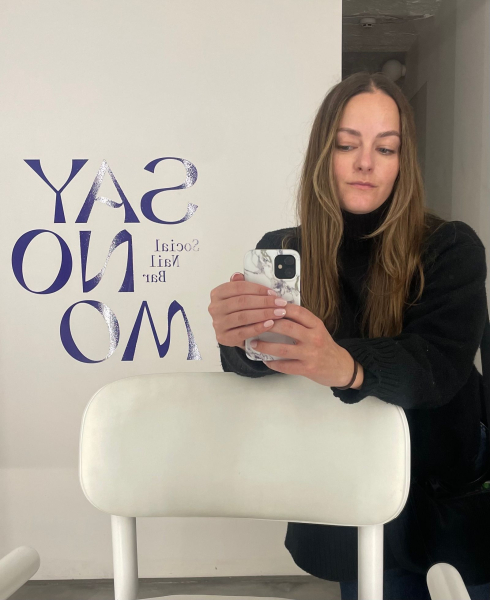
Allure content director, Sophia Panych, says the manicure she got at Say No Mo salon in Kyiv is “the best manicure I’ve ever had.”"
Sophia PanychWhy are Ukrainian manicures becoming more popular globally?
The increase in the availability of Ukrainian manicures across Europe and America is in no small part because of the ongoing war. Following the full-scale invasion, many Ukrainians fled their homes and became refugees in other European countries as well as the United Kingdom and the US. Some were already beauty industry professionals who began offering nail services abroad, says Ponomarenko, while others trained in their new homes. Then there were Ukrainian women who became clients of local salons. “Demanding clients, at that,” Ponomarenko notes.
Initially after expanding outside of Ukraine, Kolodii and her team found that the manicure itself—i.e., the cuticle and nail work—wasn’t a big priority in other European countries, and clients tended to only care about the color or design. “Often [the nail prep] didn't matter much, and the focus was on color as a form of self-expression,” she says.
As the manicure (nail prep) is an additional charge, clients often weren’t prepared to make the extra financial investment, and nail technicians had to work to change their minds. “In Germany, for example, people spend more on pedicures than on manicures, which was a very interesting insight for us,” Kolodii says. “Encouraging them to get a manicure was real work, because it is an extra cost in their budget.”
It’s taken time, but the standards Ukrainian women expect appear to be influencing the expectations of locals. “Initially, the demand [for a Ukrainian-style manicure] came primarily from Ukrainian women who had left the country and were looking for the level of service they were accustomed to,” Ponomarenko explains. “It soon became clear, however, that impeccable quality had plenty of appeal for local clients, too.”
Local clients are intrigued by Ukrainian manicures, which they’ve often read about online or spotted on social media, and want to see for themselves what has made them so popular. “People notice the cleanness, the standards, and the precision,” Kolodii says. “Many clients come to us after seeing the Ukrainian manicure online and want to understand what makes it different. What usually surprises them is how much time goes into the preparation and the care, not just the color, and how long the results last. Once they try it, they come back.”
When Ponomarenko’s goddaughter, Kateryna Bondarenko, opened her salon, Perle, in Vienna, Austria, the team worked from 8 a.m. to 9 p.m., seven days a week, for the first few weeks—because the demand among locals was so high.
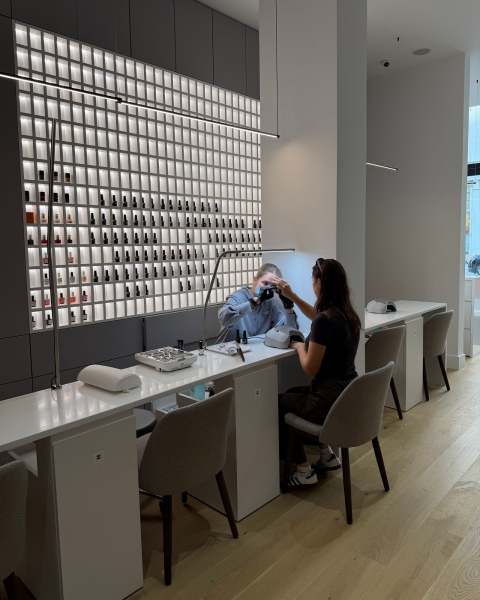
Ukrainian nail artists pride themselves on their attention to detail. At MVK Salon in New York City, a manicurist inspects her client’s cuticles.
MVK Salon
In London, Ukrainian salon chains like So.Shell and Pied-de-Poule have expanded since 2022, now with multiple locations across the capital. So.Shell opened its first salon in December 2022, just off Carnaby Street, staffed by several Ukrainian refugees. Today, according to cofounder Masha Sharova, 95% of the So.Shell team is from Ukraine, with more than 100 members having come to the UK after the start of the war. “We also run our own academy, where we train people in the Ukrainian manicure technique and beyond,” says Sharova. “And it's not just Ukrainians we train, but local British nail technicians, too.”
Ukrainian salons and manicure services have been growing in the US recently, too. G.Bar opened its Los Angeles salon in 2020, while MVK opened its first salon outside of Europe this year, in New York City. Kolodii says this was MVK’s most challenging opening to date. “I won’t sugarcoat it, this whole experience has been very hard,” she says, citing differences between Europe and America and in finding the right talent. “We made many mistakes and learned from them, but it was a real educational moment for us.”
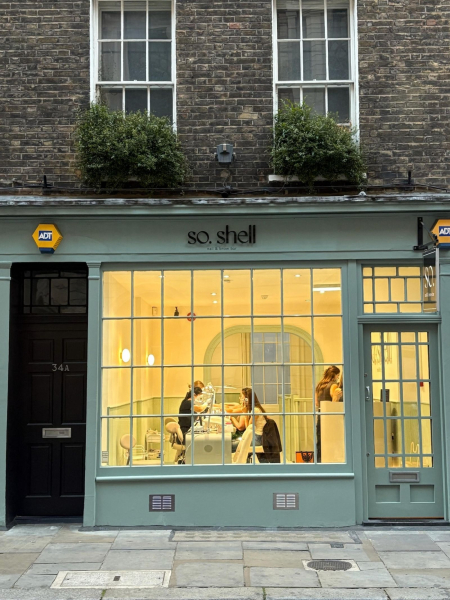
So.Shell was one of the first Ukrainian salons to open in London after the full-scale invasion in February 2022. There are now six locations, including the salon off of Carnaby Street, shown here.
So.Shell
In the US, there were noticeable differences in terminology and definitions. "In Ukraine, a regular manicure means a bare manicure—just cuticle work and shaping—with no color,” Kolodii continues. “In the US, people understand it as a manicure with color included. We were often talking about different things without realizing it.” The Ukrainian team was also used to charging separately for each element—care, cuticle work, nail coatings, etc.—while in the US, this is usually counted as one service.
Despite the challenges, Ukrainian salon owners and manicurists in the US are optimistic. “I think we will see more Ukrainian salons [in the US in future], but what is also important is that [American] salons are learning our techniques,” says Viktoriia Voloshyna, award-winning nail educator and founder of Tory Pro Nails in Beverly Hills, California. “The level of the nail industry here has been developing very fast in the last few years. Nail techs are learning new techniques and improving the quality of their services, and I think this will continue to grow.”
“For me, that’s probably the coolest part,” says Valeriia Telemaniuk, nail artist, educator, and founder of Altera Nails in San Diego. "I learned this approach in Ukraine, brought it with me to the US, and now I get to teach it to nail professionals across the country. It feels like we’re at the beginning of a new era in the American nail industry, and I’m very happy to have a front-row seat.”
Looking back on any nail appointments I’ve had over the past couple of years, I can’t remember the last time I had a non-Ukrainian manicure. I keep booking them for the durability, flawless apexes, and attention to detail. To quote Allure’s content director, Sophia Panych, who is of Ukrainian heritage: “Ukrainian women know nails.”
Ponomarenko also sums it up well: “Who could resist a manicure so glossy you can practically use it as a mirror? One that wears flawlessly for three weeks, makes your hands look beautiful and instantly lifts your mood? I have a feeling Ukrainian manicures have a very big future ahead of them.”